
In this article, we describe some best practices in how to set up case packers on your egg grading lanes. We cover where to best place them and what grader settings to use to improve your return on investment.
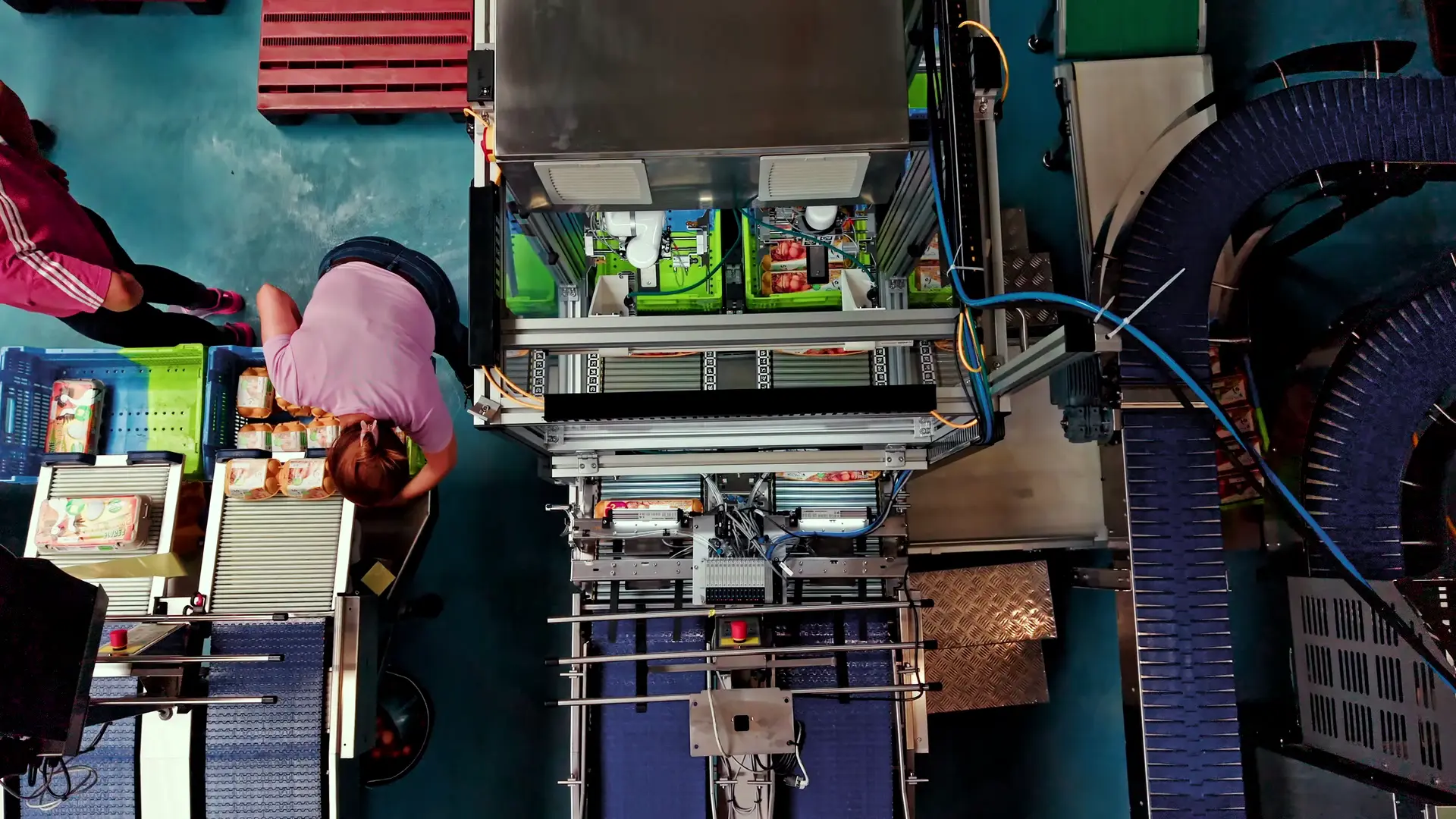
Case packers can greatly improve the productivity of your egg grading and packing operation. Instead of manually placing products into cases, operators can focus on supplying packaging materials, quality control, and other higher-value tasks. Many case packers pack significantly more boxes per hour than people can when serving the same lanes.
However, the productivity gain from implementing case packers in egg grading operations depends on how well it works together with the upstream egg grader. A fast robot is of little benefit if it is frequently starved of eggs and it can’t run at full speeds. To achieve the best possible return on investment on your machines, you need to make sure that they run all the time and at the highest possible capacity.
This article describes some of the most important considerations when integrating case packers with egg graders.
The first decision is where on the grader to install the case packers.
As a general rule, automated case-packing lanes should be as early on the grader as practical, while still leaving packing lanes required for cracks, off-grades, trays, or special products ahead of them.
In most egg packing stations, the first one or two packing lanes are used for cracked eggs or other off-grades. Removing these eggs early reduces the amount of time they spend inside the grader. This reduces the cleaning workload and the risk of damaged eggs breaking further downstream.
This is not universal, but for most grading operations, packing lanes 3 and 4 are often the first suitable pair for a case packer.
The main reason is what happens when the case packer cannot accept more products.
This can happen because:
When this happens, the corresponding packing lane is set to full and the grader stops assigning eggs to it. Eggs that would otherwise have gone to that packing lane are instead distributed to other suitable lanes farther downstream.
The more lanes that remain after the case packer, the easier it is for the grader to redirect this additional flow.
There is some delay between a packing lane becoming full and the flow of eggs to that lane stopping completely. Eggs may already have been assigned to that lane and be travelling through the grader. Therefore, it is useful to have several downstream lanes available rather than relying only on the neighboring packing lane.
This is why we recommend leaving at least two additional pairs of packing lanes downstream of the last case packer, and preferably more where the grader layout allows it.
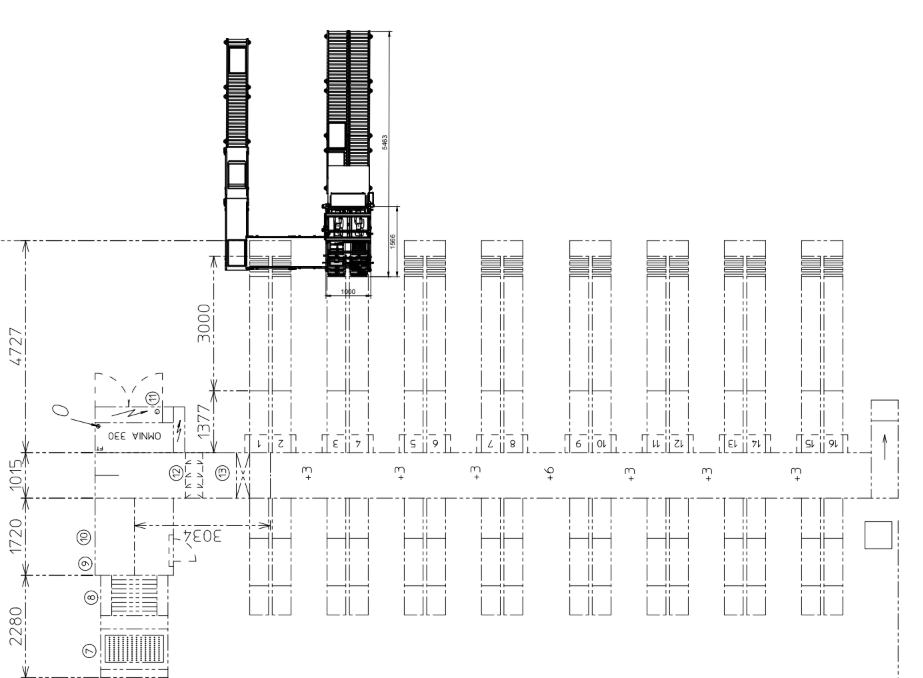
Figure 1: Example Omnia FT floor plan showing a case packer on packing lanes 3 and 4 and several downstream packing lanes available for redistribution.
A dual-lane case packer normally has the same packing capacity on both lanes. To use the equipment efficiently, you should supply similar quantities of eggs to both lanes.
This becomes particularly important when grading by weight.
The weight distribution of incoming eggs is rarely uniform. Individual farm lots or flocks often contain predominantly one weight class, and the distribution changes with flock age. One incoming lot may therefore consist mainly of medium (M) eggs, while another contains mostly large (L) eggs.
With manual packing, uneven lane loading is usually easy to handle.
An operator working between an M lane and an L lane can simply spend more time packing whichever lane currently receives more eggs.
An automated case packer is less flexible in this regard. If one lane gets 12,000 eggs per hour while the second does only 3,000, the robot on the second lane will spend much of its time waiting, leaving capacity unused.
Where product specifications allow it, the simplest solution is to send a broader weight range to the automated packing lanes.
The grader then has more flexibility to distribute eggs between the lanes according to available capacity rather than being constrained by a strict grade.
If M and L eggs have to remain separate products, both case-packing lanes can instead be assigned dynamically to the dominant weight grade.
For example:
The grader operator changes the lane assignment when the incoming weight distribution changes.
This is generally more efficient than permanently dedicating one automated lane to M and one to L.
Smart production planning can improve utilization further.
If the approximate weight distribution of incoming farm lots are known, lots with similar egg weights can be processed consecutively. A plant might, for example, run predominantly M-producing flocks in the morning and predominantly L-producing flocks in the afternoon.
Incoming lots can be grouped using flock information, historical average egg weights, or sampling before grading.
This reduces product changes and makes it easier to keep all automated packing lanes running at full capacity.
When operating a case packer, we recommend using the Capacity Control function on the connected packing lanes.
Instead of allowing the grader to send as many matching eggs as possible to a packing lane, Capacity Control lets the operator specify a target flow in eggs per hour.
Capacity Control is particularly useful for robotic packing because the achievable case-packing speed varies with the consumer pack, transport case, and packing pattern.
Packing 10-egg cartons into an EPS 156 plastic crate may have a different maximum capacity from packing 6-egg cartons into a 144-egg cardboard case.
The grader setting should be adjusted whenever the product changes.
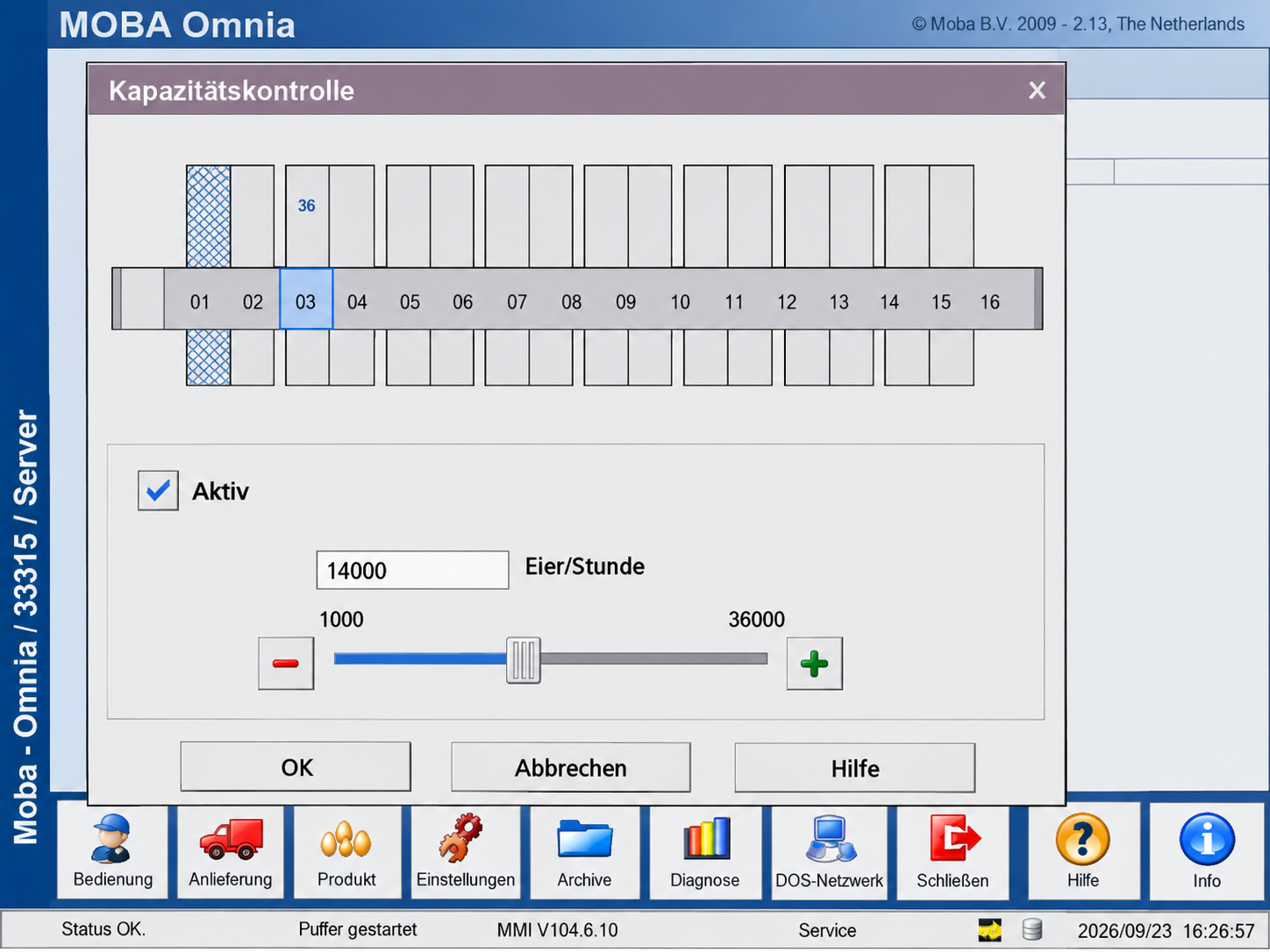
Figure 2: An example of using Moba’s Capacity Control Feature to set the target flow to 14,000 eggs per hour on lane 3.
Counterintuitively, the Capacity Control setpoint does not need to be exactly equal to your maximum case-packer speed.
Egg flow through a grader is not perfectly continuous. Even if a case packer lane can process 20,000 eggs per hour, there will often be periods when fewer eggs of the required grade arrive at its packing lane.
If Capacity Control is also set to exactly 20,000 eggs per hour, these gaps leave the case packer waiting and reduce its average productivity.
We therefore recommend setting the target lane speed approximately 5–10% above the maximum case-packer capacity.
During periods with high supply, the additional consumer packs are accumulated between the packing lane and the case packer. During short gaps in supply, the case packer works through the buffer instead of waiting.
If the buffer becomes full, the case packer activates the packing lane's full signal, and the excess eggs are assigned to other suitable lanes.
The objective is not to perfectly match the instantaneous egg flow to the robot. Instead, the grader, accumulation buffer, case packer, and bypass mechanism work together to keep the robot’s running at full speed.
Setting the value much higher than necessary provides little benefit. It fills the buffer faster and causes the packing lane to go into bypass more frequently.
Consider a Moba Omnia FT with a two lane case packer connected to packing lanes 3 and 4.
Assume the current carton and case combination gives the case packer a maximum capacity of: 20,000 eggs/hour per lane
A reasonable starting point for Capacity Control would be 21,500 eggs/hour per lane. This is around 7% above the nominal case-packer capacity.
If both lanes receive enough eggs, the grader can therefore initially send up to approximately 40,000 eggs per hour towards the two automated lanes.
The case packer itself processes up to approximately 40,000 eggs per hour. The short-term difference is absorbed by the accumulation conveyors in front of the robots.
When the incoming egg flow temporarily drops below 40,000 eggs per hour, the case packer continues working from the accumulated consumer packs and remains productive.
If one conveyor fills completely, the case packer activates the full input on that Moba packing lane. The grader then stops sending additional eggs to this lane and assigns them to other suitable packing lanes downstream.
Once the full buffer sensor is clear again, the full signal is released and the grader supplies the lane again. This keeps things running at maximum capacity.
To get the most value out of your automated case packers, it usually comes down to these simple principles:
With these points considered during layout, grader configuration, and production planning, the egg grader and case packer can operate as one coordinated packing system and the robots can spend more of the day actually packing cases.

Johannes is the co-founder of Witty Machines.
